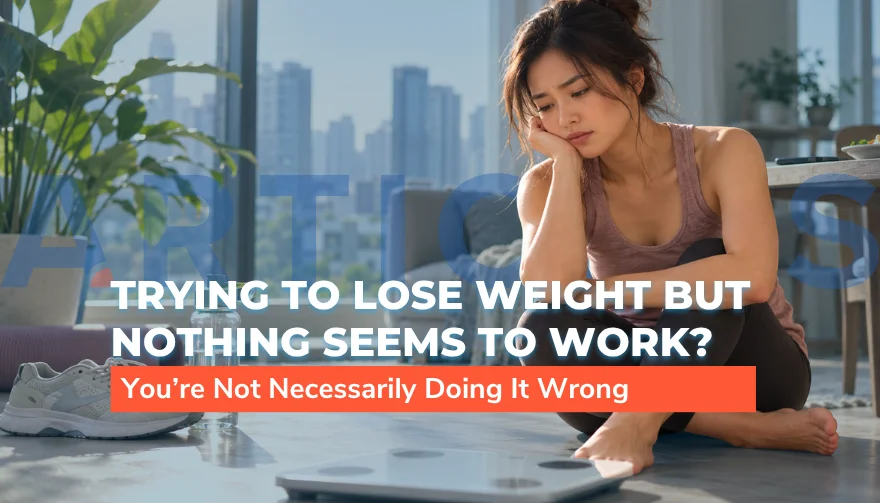
You cut back on dessert. You start walking more. You even make it through an entire week without ordering takeaway.
Then you step on the scale.
Nothing.
Maybe it’s down by half a kilogram. Maybe it has gone up. Or maybe it has been sitting stubbornly around the same number for what feels like forever.
At some point, the questions start creeping in: Am I eating too much? Am I not exercising enough? Why does this seem so much easier for everyone else?
Here’s something worth hearing before you blame yourself: struggling to lose weight doesn’t automatically mean you lack discipline.
Weight is influenced by far more than what you put on your plate or how many times you make it to the gym. Sleep, stress, appetite, hormones, medications, muscle mass, calorie intake, and even your expectations can all play a role.
Sometimes, understanding what is really getting in your way is more useful than trying even harder.
You’re Doing “Everything Right” — So Why Isn’t the Scale Cooperating?
Weight loss is often presented as a straightforward formula. Eat fewer calories, burn more through activity, and the numbers should eventually follow.
There is truth to that. Your overall energy intake still matters. But the human body doesn’t operate like a calculator where every meal produces an immediate, predictable change on the scale.
Your weight can move because of changes in body water, digestion, muscle and fat. A hard workout can leave you temporarily holding more water while your muscles recover. Building muscle can also change your body composition without producing the dramatic drop on the scale you were hoping to see.
So before deciding that your efforts aren’t working, it helps to look beyond the number staring back at you from the bathroom scale.
Maybe Sleep Is the Missing Piece
Here’s a weight-management factor that often gets pushed aside: sleep.
When you’re exhausted, healthy choices can suddenly require an unreasonable amount of effort. You may feel hungrier, crave more energy-dense foods or have less energy to cook, exercise and stick to the routine you carefully planned.
That’s not an excuse to abandon healthy habits. It’s a reminder that your body doesn’t exist separately from your lifestyle.
If you’re sleeping badly night after night, trying to compensate by eating less and exercising more may leave you fighting an uphill battle. Research and clinical guidance have linked inadequate sleep with appetite, food choices, energy and weight-related outcomes, making sleep an important part of the bigger weight-management picture.
Stress Has a Way of Getting Involved, Too
Then there are the days when life is simply a lot.
Work is stressful. The kids need something. You’re eating dinner at 9 pm because you forgot to eat earlier. Exercise has been pushed to the bottom of the list for the third week in a row.
And somehow, you’re still supposed to have the discipline to make the “right” choice every single time.
Stress can affect eating behaviour, sleep and how much energy you have for physical activity. For some people, that means reaching for food for comfort; for others, it means skipping meals all day and overeating later.
This is why telling someone to “just have more willpower” can be frustratingly unhelpful. Sometimes the problem isn’t that you don’t care enough about losing weight. It’s that you’re trying to manage your weight while managing everything else, too.
Your Appetite Isn’t Always Working Against You
Hunger can also make weight management considerably harder than a meal plan makes it look.
You can plan the healthiest lunch in the world, but if you’re ravenous two hours later, that plan will eventually be tested.
And appetite isn’t determined by willpower alone. Sleep, stress, eating patterns and the body’s biological signals can all influence how hungry you feel.
That is partly why sustainable weight loss tends to work better when it isn’t built around constantly fighting hunger.
Instead of asking, “How little can I eat?”, a more useful question may be, “What kind of eating pattern can I actually maintain?”
There May Be More Going On Behind the Scenes
Sometimes, persistent weight difficulty deserves a closer look.
Certain health conditions can affect weight, and some medications can contribute to weight gain or make weight loss harder. Hormonal changes can matter, too. For some people, conditions such as thyroid disorders or PCOS may be part of the explanation.
That doesn’t mean a hormone problem causes every unexplained kilogram. Nor should anyone stop a prescribed medication because they’re worried about their weight.
It simply means that if you’ve been making consistent changes and your results aren’t matching your efforts, you should discuss your medical history with a healthcare professional.
You may be missing something.
Losing Weight Doesn’t Mean Losing Muscle Shouldn’t Matter
Here’s another part of weight loss that doesn’t get nearly as much attention as the number on the scale: what you’re actually losing.
When people talk about dropping 10 kilograms, they usually aren’t thinking about whether those kilograms came from fat, muscle or other changes in body composition.
But preserving muscle matters for strength, function and overall health. That’s one reason protein intake and resistance exercise can be important parts of a weight-management approach, particularly when someone is losing weight with the help of medication.
In other words, the goal isn’t simply to become lighter at any cost.
You want to improve your health, not just win a competition against your bathroom scale.
And Maybe Your Expectations Are Part of the Problem
The internet has made this even harder.
Someone loses 8kg in two months and posts the before-and-after photos. Someone else claims they transformed their body by cutting out one particular food. Another person says they finally found the “secret”.
You look at all of this and wonder why your own progress feels so slow.
But real weight management rarely looks like a perfectly straight line. Some weeks, nothing seems to happen. There may be fluctuations that have nothing to do with whether you’ve been “good” or “bad”.
A sustainable approach isn’t necessarily the one that produces the most dramatic result the fastest. It’s the one you can continue living with.
What If Lifestyle Changes Aren’t Enough?
None of this means food and exercise don’t matter. They absolutely do.
But sometimes you’ve genuinely been trying, and you need more support.
That’s where weight loss medication may enter the conversation for medically suitable people. Prescription medications can be used alongside lifestyle changes as part of a broader weight-management plan. They aren’t a shortcut, and they aren’t appropriate for everyone, but they can be another tool for people who need more help than lifestyle changes alone are providing.
And there is nothing inherently shameful about that.
We don’t tell someone with high blood pressure that needing medication means they failed at taking care of themselves. Weight management deserves a similarly thoughtful conversation.
Maybe You Don’t Need to Try Harder. Maybe You Need to Look Closer.
If you’ve been trying to lose weight and nothing seems to work, take a step back before deciding that the answer is another stricter diet or another punishing workout routine.
Look at the bigger picture. How are you sleeping? How stressed are you? Are you constantly hungry? Are you eating enough protein? Could medication, hormones or an underlying health issue be playing a role? Are you measuring progress only by the scale?
These questions aren’t excuses. They’re clues.
And sometimes, the most useful change you can make isn’t pushing yourself harder. It’s figuring out what your body actually needs.
If you’re struggling with weight management despite making lifestyle changes, speaking with a healthcare professional can help you understand what may be affecting your progress and whether additional support, including weight loss medication, could be appropriate.
GoMed Singapore offers doctor-led weight-management consultations where you can discuss your health profile, goals, and treatment options with a licensed doctor.
Not losing weight doesn’t automatically mean you’re doing it wrong.
Sometimes, you just haven’t found the approach that works for you yet.